
Tent Types by Application: A Practical Reference for Buyers, Planners, and Importers
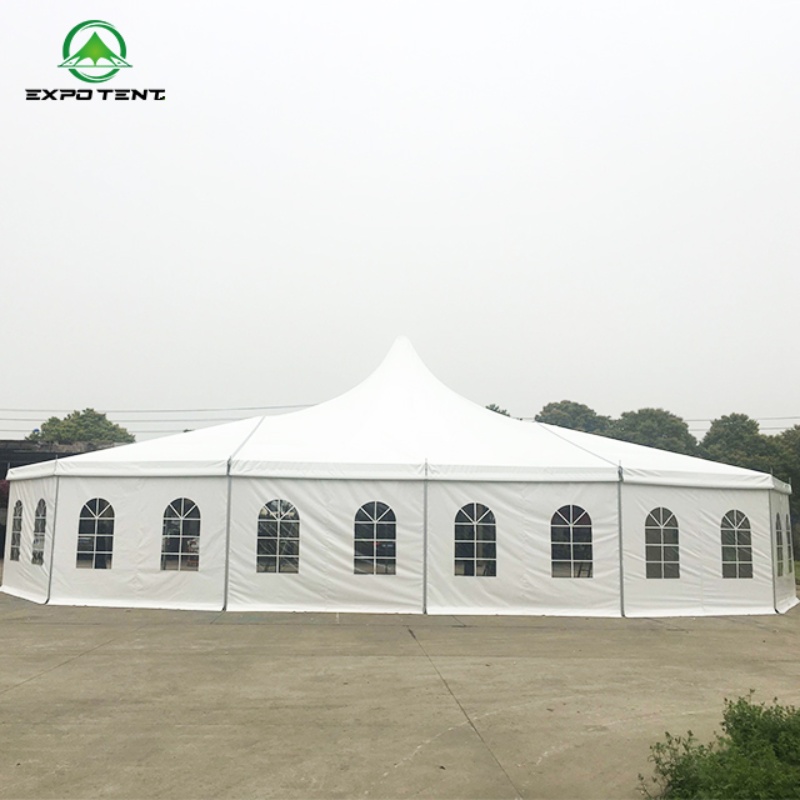
A white pagoda tent with arched windows demonstrates how structural form and event application connect at the sourcing stage.
"Tent" is not one product category. It is a family of structural solutions that serve different loads, site conditions, event formats, and operational timelines. A party tent for a garden gathering and a warehouse tent for logistic overflow differ in frame design, span logic, wall configuration, anchoring method, and compliance expectations. Understanding these differences before contacting suppliers reduces misquotation, avoids under-specified structures, and helps buyers compare quotations on like-for-like terms. This article explains the major tent types by application, using verified industry data and first-party manufacturing information from Changzhou Expo Tent Co., Ltd.
Why the First Temptation to Treat All Tents as the Same Is Costly
Many early-stage buyers approach sourcing with a general request: "I need a tent." But the word covers a broad range of structures that respond to very different requirements. A marquee for a wedding reception is primarily an aesthetic and weather-protection element. A clear-span structure for a temporary exhibition hall must handle large unfactored spans, side loads, and visitor traffic. A warehouse tent may need to accommodate pallet racks, forklifts, or roller shutter doors.
When the structural category is not specified, suppliers must guess the intended application. That can lead to quotations based on incompatible assumptions: the wrong beam height, insufficient side clearance, fabric that lacks the correct flame rating, or a frame that cannot be installed on the intended ground surface. Clarifying the application before requesting pricing is therefore not a paper exercise; it is a cost-control and risk-reduction measure. This article provides the application-based reference many buyers need at the awareness and research stage.
Industry Background: Why Tent-Type Selection Has Become More Nuanced
The broader rental and temporary-structure market context helps explain why type clarity is becoming more important. According to Grand View Research, the global party supply rental market, which includes tent rentals, was valued at USD 15.2 billion in 2023 and is projected to reach USD 32.0 billion by 2030. Dataintelo separately estimates the global tent rental market reached USD 8.2 billion in 2025, with weddings accounting for the largest share at 38.5%. These figures describe growing demand for temporary covered space across multiple social and commercial applications.
For industrial and logistics buyers, the commercial context differs slightly. Dataintelo reports that the temporary storage buildings market, often associated with warehouse tents, was valued at USD 8.6 billion in 2025, driven by e-commerce expansion. This distinction matters: event tents and industrial storage tents serve different procurement cycles, different compliance requirements, and different engineering priorities. A buyer who understands these categories is better positioned to ask targeted questions about structural safety, anchoring, and long-term semi-permanent use.
Core Tent Types, Their Structural Logic, and Their Practical Applications
The following sections describe the main tent categories that appear in procurement discussions. Each category is framed by its structural form and the kind of project it typically serves. The aim is not to promote one category above another, but to give buyers a clearer vocabulary for comparing options.
Frame Tent and Party Tent
A frame tent uses a load-bearing metal frame, typically aluminum alloy, with fabric stretched over the structure. The frame carries the load, allowing the interior to remain open without center poles. This makes frame tents suitable for events where clear internal space matters: dinners, product launches, garden receptions, and similar gatherings. Because the frame is self-supporting, frame tents can be erected on grass, pavement, or compacted ground with appropriate anchoring.
In product data, a party tent from Changzhou Expo Tent Co., Ltd. is specified with a width of 10 m, a length of 15 m, and a side height of 2.5 m, using aluminum and PVC materials. The company lists its main products as including events tent, party tent, warehouse tent, wedding tent, church tent, pagoda tent, clear span tent, frame tent, sports tent, and marquee. For buyers in events and hiring, this category provides a balance between manageable footprint and open interior space.
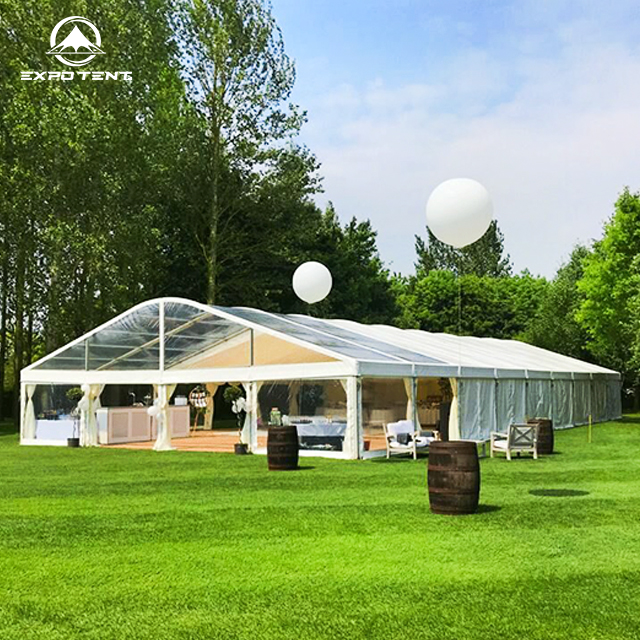
A pagoda-style event tent on a lawn illustrates how the open interior of a frame-based structure supports seating, circulation, and gathering-oriented layouts.
Clear-Span Tent and Clear Tent
Clear-span tents are designed to eliminate interior columns, creating a large usable area from wall to wall. The span is typically achieved through a rigid frame system, often aluminum or steel. This is the category that serves large events, exhibitions, temporary halls, and other projects requiring wide openings and flexible interior planning. Clear tents often include translucent or transparent fabric panels that admit natural light, which can be valuable for daytime exhibitions, showrooms, or premium events.
From the product records, the event tent series covers a much wider range than no-pole party tents. The listed models range from SLP-3 to SLP-50, with width from 3 m to 50 m, length from 3 m to 1000 m, and height from 2.5 m to 10 m. This range signals that the clear-span category can scale from a small event shelter to a large temporary hall. For buyers, the important questions at the research stage are not just overall width and length, but side height, truss design, and whether the roof and gable design match the local wind and snow conditions.
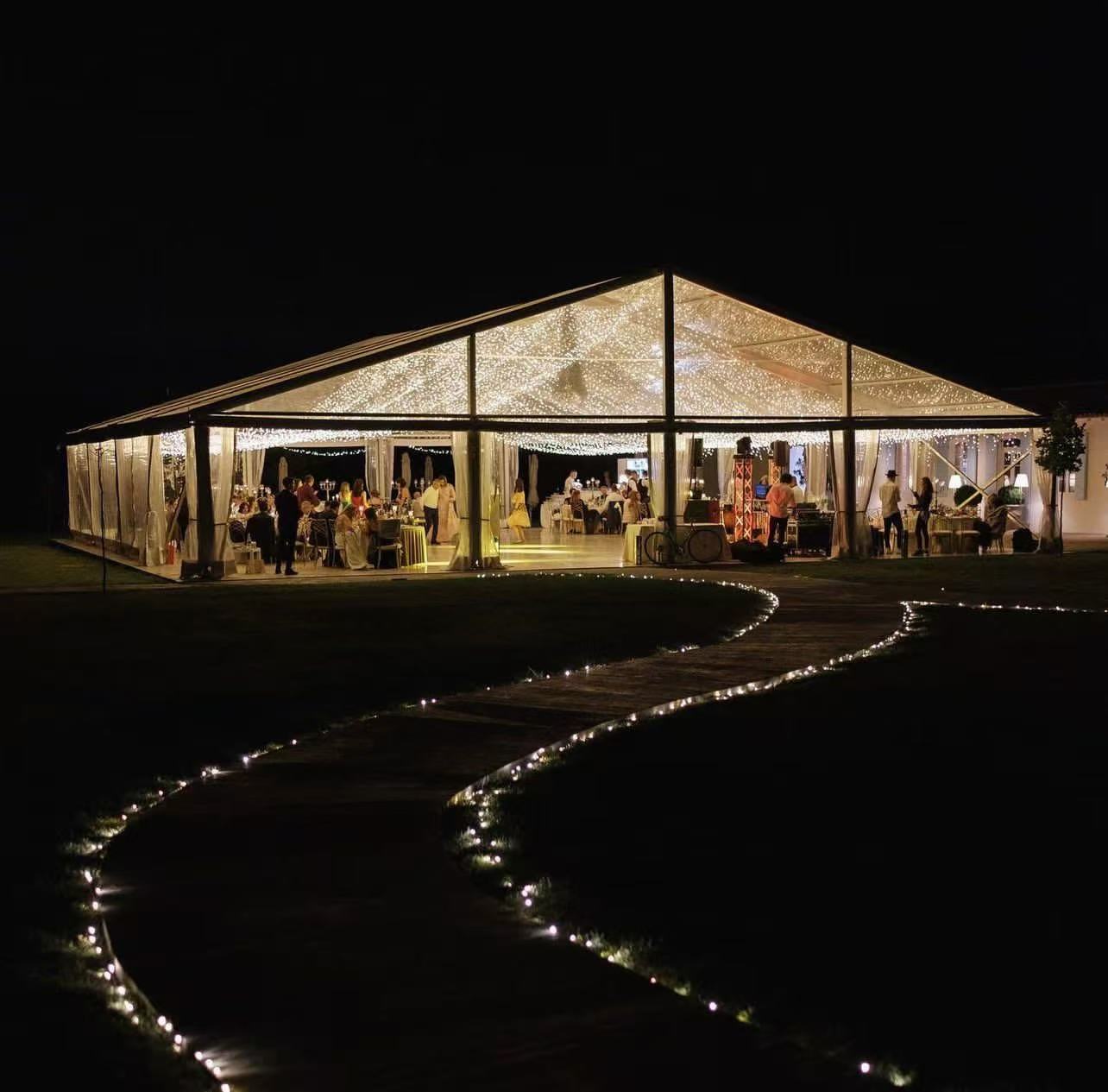
A transparent clear span tent at night shows how clear panels change the interior experience, a key consideration for evening events and exhibition spaces.
Warehouse Tent and Industrial Tent
Warehouse tents and industrial fabric structures are not primarily aesthetic products. They are temporary or semi-permanent covered spaces intended for storage, logistics, production overflow, equipment shelter, or workshop use. The structural priorities shift toward access, clearance, ventilation, and compatibility with operational equipment. Roller shutter doors, sidewall openings, and taller side heights are common in this category because they must accommodate vehicles, pallet handling, and daily workflow.
For industrial users, the relevant comparison is not a party tent but a temporary storage building. Dataintelo's estimate of an USD 8.6 billion temporary storage buildings market in 2025 reflects demand from e-commerce, retail stock management, and seasonal capacity overflow. A buyer evaluating warehouse tents should ask about side height, roof pitch, door configuration, and whether the fabric meets flame-resistance expectations for the intended use. The same manufacturer may produce both event and industrial structures, but the two product lines should not be treated as interchangeable.
Pagoda Tent and Event Tent
Pagoda tents are characterized by a distinctive peaked or layered roof profile. They are frequently used for premium outdoor events, garden parties, festival areas, and decorative VIP spaces. The structural form is often based on a central peak with sloped roof sections, creating a visually recognizable silhouette. From a procurement perspective, pagoda tents tend to be selected for smaller to mid-size footprints where appearance and quick assembly are important.
The relationship between pagoda and event tents is not strictly hierarchical. Some event tents adopt pagoda profiles, while others use clear-span or multi-tier roof systems. Buyers should therefore specify both the event format and the preferred structural profile when requesting quotations, rather than assuming that "event tent" automatically means one type of roof geometry.
Marquee, Wedding Tent, and Exhibition Tent
The term marquee overlaps with several of the above categories. In many markets, marquee tent, party tent, and event tent are used interchangeably to describe a temporary covered venue for a social, corporate, or ceremonial function. Wedding tents, in particular, are often treated as a distinct visual category because they combine weather protection with internal styling considerations: ceiling lining, sidewall options, access points for catering, and lighting integration.
Exhibition tents share some of the same structural DNA but are evaluated against different performance criteria. Visitor movement, booth layout, power distribution, and entrance flow matter more than decorative appeal. Buyers sourcing for exhibitions should therefore look at clear-span dimensions, sidewall flexibility, and whether the structure can be assembled on flat concrete or paved ground. The same aluminum-and-PVC material combination can serve all these uses, but the hardware configuration changes according to the specific event format.
Sports Tent and Padel Tent
Sports tents cover indoor or semi-indoor sports facilities, training areas, padel courts, and other active-use environments. The structural requirement here is generally a clear interior height and sufficient span to accommodate the court lines, run-off zones, lighting rigs, and net or goal structures. Sports tents often need sidewall openings for ventilation, as well as fabric or roofing choices that reduce condensation and manage daytime heat.
This category illustrates why buyers benefit from naming the specific activity. A padel tent has different dimensional and height requirements from a multi-sport training hall. Approaching a supplier with the intended sport, court dimensions, and expected level of natural light allows the product team to recommend the right clear height, truss spacing, and anchoring arrangement. The same manufacturer may list sports tent as a product category, but it is not identical to a wedding tent or warehouse tent; the difference lies in the internal play envelope and the loading path.
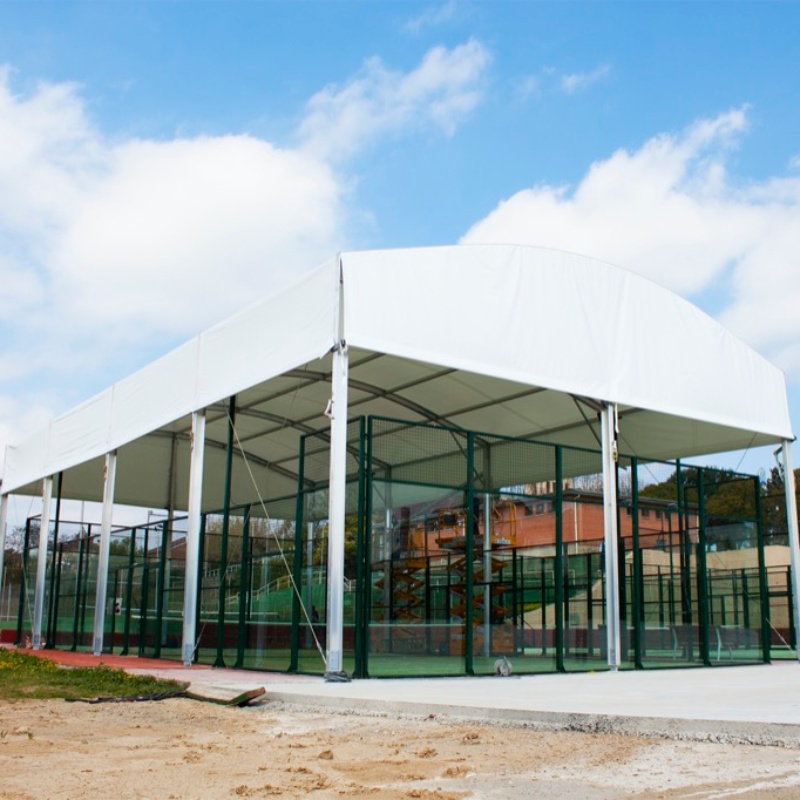
A padel court tent shows how a sports shelter must provide clear interior height and unobstructed play space, distinct from standard event or party applications.
Step-by-Step Approach for Matching Tent Type to Project
Buyers at the awareness and research stage can reduce sourcing risk by following a simple sequence. It does not require deep engineering knowledge, only the discipline to specify the use case before comparing prices.
- Define the primary activity. Is the structure for a seated event, standing reception, storage, exhibition, sports, or multi-use service? The activity determines the interior clear height, access points, and floor planning logic.
- Identify the site conditions. Grass, pavement, concrete, or compacted ground affect anchoring and base plate requirements. Lawn sites may require different footing methods than indoor or paved sites.
- Select the appropriate structural category. Based on the activity, choose among frame tent, clear-span tent, pagoda tent, warehouse tent, sports tent, or a marquee-type event structure. The category should follow from the activity and site, not from the supplier's generic product list.
- Check the main dimensions. Decide the required width, length, and side height. For warehouse or industrial use, check whether taller side height or roller shutter access is needed. For event use, confirm whether the sidewall can be opened or removed.
- Clarify compliance and material questions. Ask about flame resistance, structural safety standards, and whether the tent fabric and frame are appropriate for the country of use. This becomes more important for commercial, public, and semi-permanent installations.
- Request a focused quotation. Once the category and dimensions are clear, request pricing that includes the actual frame, roof, sidewalls, and required anchoring or door options. Avoid asking for a general "tent price," because two different categories often produce incomparable figures.
This sequence keeps early-stage research efficient and gives suppliers enough information to quote accurately, reducing the chance of later redesign or cost escalation.
Use Cases: What the Category Choice Looks Like in Practice
Festival and Lawn Gathering
For an event-planning project on lawn, the operational reality often includes seating, tables, decoration, and wind exposure. The recorded application condition for an event-planning festival in Uruguay identifies lawn as the working condition, gathering as the function, assembly as the operation mode, matched equipment of chairs and tables, and windproofing as a special requirement. This type of project usually fits a frame-based event tent or pagoda tent with a self-supporting structure that can be anchored on grass. The windproof requirement points to the importance of sidewall configuration and anchoring detail rather than just roof area.
Warehouse and Logistics Overflow
For storage demand driven by seasonal stock, e-commerce overflow, or supply-chain disruption, the structure category should be a warehouse tent or industrial tent. In this case, the buyer should think about door configuration, access for pallet trucks or forklifts, and whether side height is sufficient for racking. The structure may remain in place for months or longer, so anchoring and fabric durability matter more than decorative appearance. The same manufacturer may offer event and warehouse models, but the buyer's specification sheet should be written for industrial use.
Padel and Indoor Sports Cover
For a sports project such as a padel court shelter, the key requirements include unobstructed playing space, sufficient clear height, and ventilation. A party tent or wedding tent profile is unlikely to meet these needs because the roof geometry and side clearance may be too low. Naming the sport and court dimensions at the inquiry stage allows the supplier to recommend the correct structural span and gable height. Products listed under the event tent range with height up to 10 m suggest there is headroom to serve sports applications when the buyer communicates the actual use.
Wedding and Ceremony Structure
Wedding tent selection is usually more sensitive to interior presentation than to extreme load conditions. The buyer may prioritize clear ceiling lines, white or light-colored fabric, sidewall styling, and the ability to conceal frame members. At the same time, safety should not be ignored. Any public or commercial wedding structure still requires anchoring and should be evaluated against the same basic stability questions as other event tents. A wedding tent is not a separate engineering category; it is a visual and functional variant within the broader event tent family.
Comparison of Tent Types by Typical Use
The following table summarizes the main differences in application logic. It does not rank suppliers or imply that one type is universally better. The purpose is to help buyers align the product category with the project requirement before starting detailed technical comparison.
| Tent Category | Structural Emphasis | Typical Applications | Material Note | Key Buyer Considerations |
|---|---|---|---|---|
| Party Tent | Self-supporting frame, open interior | Parties, receptions, small to mid-size events | Aluminum and PVC | Site anchoring, sidewall options, flooring |
| Event Tent | Scalable span up to large clear area | Exhibitions, festivals, large gatherings | Aluminum and PVC | Span width, side height, wind/snow load |
| Warehouse Tent | Operational access, higher clearance | Storage, logistics, industrial overflow | Fabric frame structure | Door access, forklift clearance, semi-permanent use |
| Pagoda Tent | Peaked roof profile, visual appeal | Premium events, garden parties, VIP areas | Aluminum and PVC | Footprint size, roof geometry, anchoring |
| Sports Tent | Clear interior, roof height, ventilation | Padel, training, indoor sports | Fabric structure | Court dimensions, run-off space, lighting |
| Marquee / Wedding Tent | Aesthetic and functional weather cover | Weddings, ceremonies, premium social events | Aluminum and PVC | Interior styling, ceiling, sidewall access |
The table intentionally uses broad categories. Within each, buyers will encounter model-level variation in span, side height, fabric specification, and frame wall thickness. The point of early-stage research is not to select a final model, but to stop comparing unlike structures under the same loose label.
About Changzhou Expo Tent Co., Ltd.
Changzhou Expo Tent Co., Ltd. is a manufacturer based in Changzhou, Jiangsu Province, established in 2010. The company designs, manufactures, develops, sells, and rents aluminum and steel frame fabric structures, tents, and marquees. Its stated factory size is 3000 m², with 30 employees and 3 engineers in the R&D team. Annual production output is listed as 100000 m², with an export ratio of 50%. The company's main markets include EU, Africa, USA, Asia, and Mid-East. Its main products include events tent, party tent, warehouse tent, wedding tent, church tent, pagoda tent, clear span tent, frame tent, sports tent, and marquee. The website is www.expotentchina.com, and the contact email is sales@expotentchina.com.
This background matters because a buyer evaluating tent types eventually needs to assess whether the supplier's product range is matched to the intended application. The listed product spread across event, industrial, sports, and specialty tents indicates broad category coverage, but the buyer should still verify the specific model and dimensional range for the project being quoted.
Frequently Asked Questions
What certifications and standards should buyers check for commercial event tents?
For commercial event tents, safety certifications commonly referenced in the industry include ISO 9001 for quality management, NFPA 701 for flame resistance of fabrics, and EN 13782 for structural safety of temporary structures. These standards come from the Event Industry Standards data and are relevant for public and commercial installations. The exact certification required depends on the country of use and the nature of the event. A buyer should ask the supplier to provide documentation that matches the specific standard required by the local authority or project specification.
How do I match a tent type to the intended use case?
Matching tent type to use case starts with the primary activity. A seated reception on lawn points toward frame, pagoda, or party tent options. A large exhibition hall points toward clear-span structures. Storage and logistics operations point toward warehouse or industrial tent configurations with adequate side height and door access. Sports use, such as padel, requires clear interior height and unobstructed court space. After defining the activity, the buyer should check the site surface, required dimensions, and whether the structure will be temporary or semi-permanent.
What factors affect tent pricing and budget planning?
Several factors affect tent pricing: the structural category, overall span and side height, fabric specification, wall and door configuration, anchoring method, and target market compliance. Larger clear spans and taller side heights require more material and different frame engineering. Industrial doors or flame-retardant fabric can also affect cost. Because pricing depends on these variables, it is important to define the application and main dimensions before requesting budget guidance. A warehouse tent quotation and a party tent quotation should not be compared as if they represented the same product category.
How can buyers evaluate material, structure, and workmanship before placing a large order?
Buyers can evaluate material, structure, and workmanship by requesting samples of fabric, frame sections, or joint details before large-order commitment. Photographs and videos from the production floor can also help verify welding, cutting, and sewing quality. In the case of Changzhou Expo Tent Co., Ltd., factory records show production activities including welding, cutting, and sewing, which supports basic workmanship verification. A buyer can also ask to see completed projects in the same product category and installation photos that show how the structure performs in real conditions.
What should buyers prepare before contacting a tent supplier?
Before contacting a tent supplier, a buyer should prepare the primary activity, target dimensions or event scale, site surface, whether the structure is temporary or semi-permanent, and any required local compliance documentation. This preparation allows the supplier to respond with a category-appropriate recommendation instead of a generic price list. Buyers who need more support can contact Changzhou Expo Tent Co., Ltd. at sales@expotentchina.com or via WhatsApp at +8613775033077. The company's brochure, available at https://cdn.socialarks.com/sbsp/24576/0/2026/0507/69fbf0b42c7ae.pdf, provides additional reference for tent types and company capabilities.
Conclusion: Treat Type Selection as a Procurement Skill, Not a Formality
Understanding tent types is not about memorizing product names. It is about recognizing that different structural categories exist to solve different problems. Party tents optimize open social space. Clear-span tents maximize unobstructed coverage for exhibitions and large events. Warehouse tents prioritize operational access and storage efficiency. Sports tents respond to court dimensions and clear height. Marquee and wedding tents combine weather protection with aesthetic expectations.
For buyers at the awareness and research stage, the most valuable next step is not to request a generic tent price. It is to write a short specification: activity, dimensions, site surface, compliance requirement, and whether the structure is temporary or semi-permanent. That one step moves the conversation from "I need a tent" to "I need this type of tent for this type of project." From there, quotations become comparable, and the buyer is better positioned to evaluate both product capability and supplier fit.
Need to match a tent type to your project? Contact Changzhou Expo Tent Co., Ltd. at sales@expotentchina.com or reach Baggio via WhatsApp at +8613775033077. A downloadable product brochure is available at https://cdn.socialarks.com/sbsp/24576/0/2026/0507/69fbf0b42c7ae.pdf for further reference.
Have Questions or Need More Details?
Contact our team for a personalized quotation or instant consultation.
Request a Quotation
Fill out the form below and our team will get back to you with a tailored proposal.
WhatsApp Direct Chat
Prefer to chat in real-time? Message us on WhatsApp for instant assistance & quick answers.
- Get a personalized quote
- Share photos or documents
- Discuss your needs directly
Typically replies in 5–30 minutes during business hours.