
Party Tent vs. Event Tent: Wedding Purchase & Acceptance
A wedding buyer can receive two quotations that both say 'party tent' or 'event tent' and still be comparing different products. In wedding tent purchasing, the label is a starting point for conversation, not a specification. The practical question is not which phrase sounds more premium. It is what exact product, configuration, scope, and acceptance terms the supplier is asking the buyer to approve.
The supplied expotent content units show why this matters. Changzhou Expo Tent Co.,Ltd. (expotent) is a China-based tent company established in 2010 that designs, manufactures, develops, sells, and rents aluminum and steel frame fabric structures, tents, and marquees. In its supplied product data, the product named 'Party tent' has the type 'event tent', while the product named 'Event Tent' has the type 'Pagoda tent'. The same words move between product names and product types. That overlap is a purchasing risk if a buyer compares labels instead of written product descriptions.
The labels are not a product taxonomy
In everyday event planning, 'party tent' and 'event tent' are often used as if they describe two clean categories. The supplied content does not support that assumption. It shows a naming pattern that a buyer should check rather than a universal classification.
| Supplied field | Party tent | Event Tent |
|---|---|---|
| Product name in the content unit | Party tent | Event Tent |
| Product type in the content unit | event tent | Pagoda tent |
| Model references | SLP-10, SLP-12, SLP-15 | SLP-3, SLP-6, SLP-10, SLP-12, SLP-15, SLP-20, SLP-25, SLP-30, SLP-40, SLP-50 |
| Stated parameters | Width 10 m; length 15 m; side height 2.5 m | Width 3-50 m; length 3-1000 m; height 2.5-10 m |
| Stated material | Aluminum and PVC | Aluminum and PVC |
| Stated applicable industry | Events and Hiring | events company |
The table reproduces supplied labels and values. It is not an official market taxonomy and does not prove that every supplier uses the words in the same way.
Two details deserve attention. First, 'event tent' appears as the type of the Party tent product. Second, the product named Event Tent is typed as a Pagoda tent and offers a much wider model range. A buyer who asks only for an 'event tent quote' may receive either product family, a different model within one family, or a configuration that is not represented by the label at all.
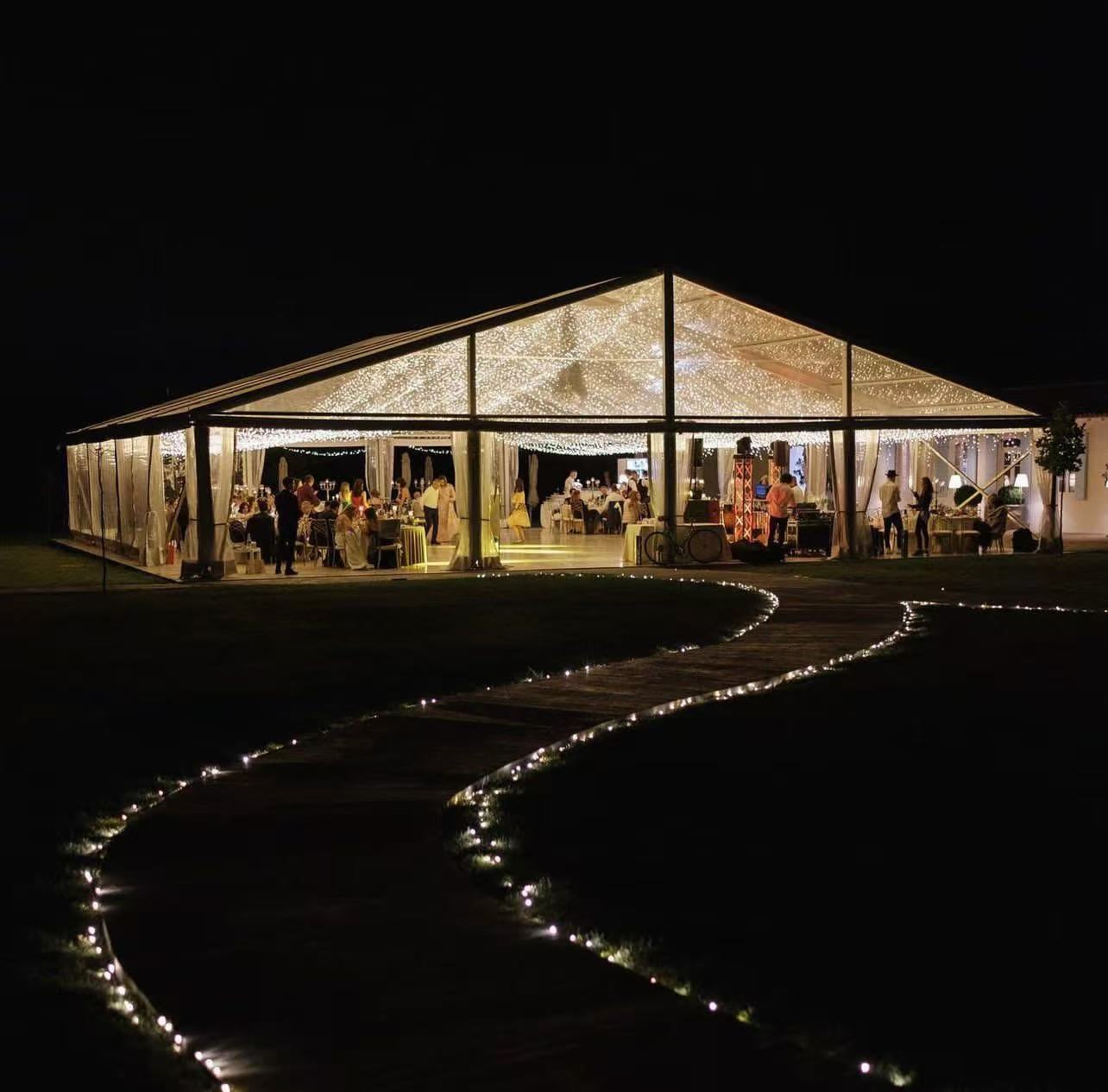
Images add another layer of ambiguity. One transparent clear-span tent image appears in the supplied image lists for both Party tent and Event Tent. That does not mean the products are identical. It means a buyer should not identify the quoted product from a photo, a label, or a model prefix alone.
What the buyer is actually agreeing to receive
In a wedding tent purchase, the buyer is not agreeing to receive a phrase. The buyer is agreeing to receive a defined product, in a defined configuration, with a defined scope and a defined handover. The label can help start the conversation, but the written product description should carry the commitment.
Product identity
Start with the exact product name, model, and type as the supplier records them. For example, a quote that says 'Party tent' should identify whether it refers to model SLP-10, SLP-12, or SLP-15, and it should state the type that appears in the supplier's own data. A quote for 'Event Tent' should identify the exact model within the SLP-3 to SLP-50 range, because a range is not a single deliverable.
Dimensions and usable space
Confirm the width, length, and side height or height values that will be delivered, rather than the range printed in a catalog. The Party tent content unit states width 10 m, length 15 m, and side height 2.5 m. The Event Tent content unit states a width range of 3-50 m, a length range of 3-1000 m, and a height range of 2.5-10 m. Ranges are useful for early planning, but acceptance should refer to the exact configuration on the order.
Materials and components
The supplied content units list aluminum and PVC as the material for both products. A purchase order should still state the material description that applies to the quoted configuration and should identify the components that are included. Do not let a general material line stand in for the full bill of supplied items. If the quotation leaves an item unstated, treat it as something to confirm in writing rather than something to assume.
Scope and exclusions
Wedding tent quotations can become difficult to compare when one price includes an item and another excludes it. The buyer should ask the supplier to list what is included and what is excluded in the quoted scope. This is not a demand for a particular commercial format. It is a way to make the price comparable and to give acceptance a clear reference point.
Site and use conditions
The supplied application scenario for event planning on a lawn includes chairs and tables, assembly, a gathering function, and a windproof requirement. For a wedding buyer, that is a useful reminder that site surface, furnishings, assembly method, and weather exposure belong in the written discussion. A tent label does not describe the site. The buyer and supplier should record the conditions that affect delivery, installation, anchoring, and acceptance for the actual event.
Documentation and compliance discussion
A product label is not proof of compliance with venue rules or local requirements. The buyer should ask which documents the supplier can provide for the exact product and market, and should verify the applicable requirements with the venue and local authority. This explainer does not certify any product. It only makes the point that compliance evidence, if required, should be discussed as a separate purchasing item rather than inferred from the words 'party tent' or 'event tent'.
Purchase terms to confirm before comparing quotes
Before comparing price, put the same questions to every supplier. The aim is to compare the same product, scope, and handover, not to collect the widest possible range of promises.
- Product identity: exact product name, model, type, and configuration.
- Dimensions: width, length, side height or height, and the usable layout assumptions for the wedding.
- Materials: the material description for the quoted configuration, including the main frame and cover items that the supplier lists.
- Scope: what is included and what is excluded in the quoted price, stated item by item.
- Site inputs: surface, access, assembly conditions, and any wind or weather exposure that the supplier needs to know.
- Delivery and installation: who arranges each step, what the buyer must prepare, and what completion means.
- Acceptance method: when acceptance happens, who attends, what is checked, and how incomplete items are recorded.
- Commercial link: how payment milestones relate to the written scope and the acceptance record.
A quote that answers these points is easier to compare than a quote that repeats the label. If one supplier provides a fixed model and another provides a range, the buyer should not treat the two as equivalent until the exact configuration is written down.
Acceptance criteria that match the order
Acceptance criteria are the checkpoints that the buyer and supplier agree to use before the product is accepted. Good criteria are observable, tied to the written product description, and agreed before the order is placed. They should not be invented after delivery, and they should not be replaced by a general statement that the tent is 'as described'.

1. Identity and quantity
Check that the delivered product matches the ordered product name, model, type, and quantity. If the order says Party tent SLP-10, the acceptance record should not simply say 'party tent received'. If the order says Event Tent with a specified model, the record should identify that model and the agreed configuration.
2. Dimensions and layout
Measure the agreed width, length, and height values against the order. Record the result in the same units used in the quotation. If the wedding layout depends on a particular clear space or side height, state that dependency before order and include it in the acceptance check where the supplier has agreed to it.
3. Materials and components
Compare the delivered materials and components with the written material description and the agreed component list. The acceptance record should identify missing, substituted, or unconfirmed items. A buyer should not sign off a material item that the quotation did not define.
4. Workmanship and condition
Record the condition of the delivered frame, cover, connections, and other agreed items. Acceptance can use a simple condition check: present, complete, and consistent with the agreed description. If an item is damaged or incomplete, record it as a nonconformance with a requested correction date rather than relying on a verbal comment.
5. Documentation and handover
List the documents that the supplier has agreed to provide for the exact product and market. The list should match what was discussed before order. Do not add a certification claim that the supplier has not supported. Do not accept a label as a substitute for a document that the venue or authority requires.
6. Installation completion
If installation is in scope, define what 'complete' means: the agreed structure is assembled, the agreed items are present, and the handover check has been carried out. If installation is not in scope, state that clearly so that acceptance does not drift into an unagreed service.
7. Open items and correction
Use a written open-items list for anything that fails the agreed check. Each item should identify the issue, the agreed correction, and the date by which it will be reviewed. Final acceptance should follow the closure of those items, not a promise that they will be handled later.
This framework is deliberately about agreed, checkable items. It does not replace engineering review, local permitting, or venue rules. It prevents a common purchasing error: treating a product label as if it were an acceptance standard.
How to discuss acceptance with a supplier
Use plain language and ask the supplier to write the answer into the quotation or order. A useful opening is: 'We are buying a wedding tent, and we need to confirm the exact product, scope, and acceptance items before we compare price.' Then ask the supplier to map each term in the brief to a product line and a checkable acceptance item.
Questions that keep the discussion specific include:
- Which exact product name, model, and type are you quoting?
- Which dimensions apply to this quotation, and which values are only a catalog range?
- What is included and excluded in the quoted price?
- What site conditions do you need us to confirm before you finalize the scope?
- What will we check at handover, and how will incomplete items be recorded?
- Which documents, if any, are you providing for this exact product and market?
- How do payment milestones connect to the written scope and acceptance record?
If the supplier answers with a label rather than a product identity, ask again. If the answer changes between the quotation, the drawing, and the order, ask for a written revision. Acceptance is easier when the buyer and supplier use the same words for the same item.
Scenario and feature labels in a wedding brief
Wedding buyers often use descriptive phrases such as outdoor lawn wedding tent, beach wedding special tent, castle wedding decoration tent, commercial wedding planning tent, hotel wedding supporting tent, large-space wedding tent, windproof and waterproof wedding tent, custom-size wedding tent, detachable modular wedding tent, and quick-storage wedding tent. These phrases can be useful for a brief, but they are not self-defining purchase terms.
The same applies to the party tent and event tent labels. Each phrase should be translated into a product identity, a scope item, and, where relevant, an acceptance check. For a lawn setting, confirm the surface and assembly conditions. For a beach setting, confirm access and anchoring discussion with the supplier. For a hotel or commercial planning context, confirm the venue interface and handover responsibilities. For a large-space or custom-size brief, confirm the exact model and dimensions rather than the catalog range. For a detachable modular or quick-storage requirement, confirm what is actually supplied and how it is checked. The point is not to multiply labels. It is to stop a label from hiding an undefined commitment.
Frequently asked questions
Does the 'party tent' or 'event tent' label tell me which product will be delivered?
No. The supplied expotent content units show that 'event tent' is the type of the product named Party tent, while the product named Event Tent is typed as a Pagoda tent. The label alone does not define the model, dimensions, configuration, or scope. The buyer should confirm the exact product name, model, type, and written description before comparing quotes.
Which purchase terms should I confirm before comparing wedding tent quotes?
Confirm product identity, exact dimensions, material description, included and excluded scope, site conditions, delivery and installation responsibilities, acceptance method, and the link between payment milestones and the written scope. If one quote uses a fixed model and another uses a range, ask for the exact configuration so that the two offers can be compared on the same basis.
How should price and inclusions relate to acceptance?
Price should be tied to a written scope, and acceptance should check the items in that scope. A lower price is not a like-for-like comparison if it excludes an item, uses a different configuration, or leaves acceptance undefined. Before order, ask the supplier to state what is included, what is excluded, and what will be checked at handover.
Is a sample or pre-production check useful for a custom-size wedding tent?
For a custom-size or large-space requirement, a drawing review or pre-production confirmation can help both sides agree on the exact configuration before production. It does not replace the final acceptance check, and it should not be treated as proof of a certification or performance claim. Its purpose is to reduce ambiguity about the product the buyer is agreeing to receive.
How should delivery and lead time appear in acceptance terms?
Delivery and lead time should be written as agreed milestones with clear responsibilities. The buyer should know what must be ready on site, who arranges each step, and what completion means. If an item is incomplete at handover, record it in a written open-items list with a correction date. Final acceptance should follow the agreed checks, not a general assurance that the remaining items will be handled later.
If you are preparing a live wedding tent inquiry, ask expotent for a written product description and acceptance checklist for the exact model you are considering. That keeps the conversation on the product and the handover, not on the label.
Conclusion
Party tent and event tent are useful words for starting a wedding tent conversation, but they are weak foundations for a purchase. The supplied content units show why: the product named Party tent is typed as an event tent, and the product named Event Tent is typed as a Pagoda tent. Model ranges, dimensions, and image lists overlap. A buyer who compares those labels without a written product identity is comparing ambiguity with ambiguity.
The safer path is straightforward. Confirm the exact product name, model, type, dimensions, material description, scope, exclusions, site conditions, delivery responsibilities, and acceptance method. Then compare price on that written basis. The buyer does not need a longer label. The buyer needs a clearer commitment.
For a documented reference point, the expotent brochure can be downloaded here: Download the expotent brochure (PDF). Use it as a starting point for a written inquiry, and keep the acceptance criteria specific to the exact product and wedding site.
Have Questions or Need More Details?
Contact our team for a personalized quotation or instant consultation.
Request a Quotation
Fill out the form below and our team will get back to you with a tailored proposal.
WhatsApp Direct Chat
Prefer to chat in real-time? Message us on WhatsApp for instant assistance & quick answers.
- Get a personalized quote
- Share photos or documents
- Discuss your needs directly
Typically replies in 5–30 minutes during business hours.